| |||
Serving the Towns of Wawarsing, Crawford, Mamakating, Rochester and Shawangunk, and everything in between | |||
| |||
| |||
|


|
|
|
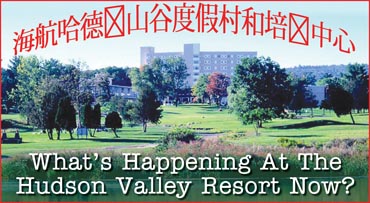
What's Happening At The Hudson Valley Resort Now?
KERHONKSON – The tides of modern capitalism are hard to predict. The sale of the Hudson Valley Resort for $13.8 million to HNA Group, for example, brought one of China's most innovative and unusual companies into our region. Few people here would have expected this, indeed few in New York really know anything about HNA, which is often described in business media as an "opaque Chinese business group."
The story centers on a remarkable businessman, Chen Feng. Back in the early 1990s, China was just beginning its shift from Maoist collectivism to communist supervised free enterprise. Chen Feng was an official with the Civil Aviation Administration of China (CAAC). He parlayed that position into becoming the business assistant to the provincial governor of Hainan province, with a focus on aviation. Hainan is the large, tropical round island that seems suspended from the south coast of China, and is referred to by its inhabitants as "the pearl of the south sea." With a single, old Boeing 737, Chen Feng launched Hainan Airlines. Mr. Feng, known for his Buddhism and adherence to a simple lifestyle without frills, worked on that first plane as an air steward, pushing the drinks cart up and down and serving passengers. Things progressed. More planes were bought. In 1995, Chen got a meeting with financier George Soros in Manhattan and flew to New York. Soros was persuaded to invest $25 million in the little airline flying out of Haikou, the capital of Hainan Island. It must have paid off handsomely. Hainan Airlines grew and grew and is China's fourth largest airline today; the top three are all state owned and centered in giant cities like Shanghai and Beijing. Out of the airline, and other lesser airlines that it spawned, Chen grew the business on a series of mergers and acquisitions. One example: in 2011 he bought General Electric's Seaco, the fifth biggest container leasing company in the world, for $1.05 billion. Along the way the HNA hospitality group grew by steady acquisitions, and now owns about 450 hotels, both in China and around the world. The group holds about $60 billion in assets around the world, all administered from a 31-story headquarters building shaped a little bit like a Buddha in Haikou. There are office buildings, including at least one in Manhattan, various hotel groups in Europe, Africa and elsewhere, and of course the airlines, with as many as 800 planes in total. Analysts have noted that HNA, and Hainan Airlines, are more interested in the world beyond China than most of their competitors. This likely reflects the ways of Hainan Island, which has always been a trading and seagoing society. At the same time, the company has undergone an exercise in "internal integration" that closed more than 300 of its companies and merged the successful parts of their businesses into major units. Core business units contracted from eight to five — concentrating on aviation, tourism, finance, logistics and commercial services. The group shed debt as well and turned back to continuing its advance into global business. Chen has said, "By 2020, we can become one of the top 100 companies in the world, and by 2030 we want to be one of the top 50." One aspect of HNA's rise is that it operates in business areas that, so far, have not drawn critical attention from the Chinese Communist Party, which keeps a wary eye on all large business groups in China. Chen is said to be very well connected politically, and his austere way of living — "I don't drink, smoke, have banquets, go to karaoke or get massages" — must also play well with the leadership under Xi Jinping, who has been running a major drive against corruption and overt displays of wealth. Chen has said, "I'm different from other entrepreneurs in China. I live a simple life." How all this will translate for the Hudson Valley Resort is unknown. HNA group does not reveal that much of its plans beyond Chen Feng's occasional interviews, where he happily discusses global expansion and its issues. Since the resort was purchased, work has been ongoing to refurbish it. Orest Fedash, the general manager of the resort, was pleasantly surprised by the arrival of the chairman when he flew in from China and was met by several other senior HNA executives, including Daniel Chen, president of HNA Group North America... and the son of Chen Feng. The group toured the facility and its grounds for a couple of hours. The resort had been in deep trouble before HNA stepped in. The previous owner, Eliot Spitzer (not the former governor) moved the business into bankruptcy protection in 2010. Much had depended, it was said, on the chance of a new owner getting approval for video lottery terminals. However, that was blocked by State Senator John Bonacic, chair of the gaming committee, who did not wish to see any competition with the soon to be built Montreign Casino in Sullivan County. Fedash, still managing the resort, adds they have been updating various kinds of equipment, and are now in the process of having different designers come in and compete for the contracts to design the bigger renovation work. "We cannot start anything before we have new plans," he said. "They will be for the new interiors for the resort." Fedash, who has been at the resort since 2006, has been very pleased with the ways the HNA people have treated the staff at the resort. "Unbelievably nice people," he says. "They plan for this to be a great destination upscale resort." The new name for the resort (printed above in Chinese) will be the HNA Hudson Valley Resort and Training Center, which implies a secondary role for the facility. Considering the scale of Chen Feng's plans, this may be an augury for more resorts and hotels across the US and Canada being brought under the HNA banner.
Copyright © 2016, Electric Valley Media LLC | Terms of Use
All Rights Reserved. |
|
|
     |
|